


Precision Redefined: How Digital Servo Winding is Revolutionizing Transformer Manufacturing
In the era of high-efficiency transformers and Solid-State Transformers (SST), the margin for error in coil winding has vanished. Traditional mechanical winding machines, reliant on friction brakes and gearboxes, struggle to meet the stringent demands of modern grid standards like GB 20052-2024 and IEEE/UL certifications.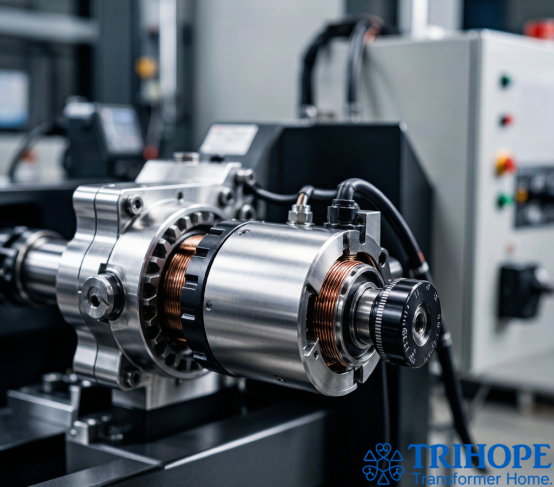
Enter Digital Servo Winding Technology. By integrating high-resolution encoders, PLC-controlled servo motors, and real-time tension feedback systems, Trihope’s Digital Servo Winding Machines eliminate mechanical backlash and human variability.
Traditional Winding vs. Digital Servo Winding: A Comparison
|
Feature / Parameter |
Traditional Winding Machine (Mechanical / Stepper) |
Digital Servo Winding Machine |
|
Drive System |
AC motor + gearbox / friction wheels or open-loop stepper motors. |
Multi-axis fully digital servo drives with high-resolution encoder closed-loop control. |
|
Winding Accuracy |
±0.1–0.2mm. Prone to backlash and wear; accuracy degrades over time. |
±0.01–0.02mm. Optical encoder closed-loop control; zero backlash; long-term stability. |
|
Tension Control |
Mechanical friction or powder brakes. Tension fluctuates significantly (±10–20%) with spool diameter changes, risking wire breakage or loose layers. |
Digital Closed-Loop Constant Tension. Real-time compensation for wire/spool variations; fluctuation ≤±3%. |
|
Start/Stop Performance |
High-speed starts/stops easily damage wire enamel, causing overlapping or loose windings. |
S-curve acceleration/deceleration for soft start/stop, protecting wire insulation integrity. |
|
Changeover Time |
Requires physical gear/cam changes and manual alignment (30–120 mins). |
Load digital recipes (wire size, turns, pitch); changeover in 3–10 minutes. |
|
Recipe Storage |
Relies on operator experience or paper records; not traceable. |
Stores ≥100 process recipes; logs tension/speed/layer data per turn, exportable as CSV. |
|
Data Traceability / MES |
No interface or basic counting only. |
Standard Ethernet/RS485; optional OPC UA / PROFINET for MES/SCADA integration. |
|
Application Scope |
High-volume, low-spec distribution transformers or repair shops. |
High/Low voltage coils, Dry-type/Oil-immersed transformers, Reactors, SST High-Freq Windings. |
|
Scrap / Rework Rate |
Higher (loose layers, turn-to-turn shorts, dimensional errors). |
Reduces scrap due to breakage/looseness by 60–90%. |
|
Energy Efficiency |
High friction losses; consumes power even when idle. |
Servo energy recovery; ~25–30% energy savings vs. traditional models. |
|
Maintenance |
Frequent replacement of gears/belts/brake pads; accuracy declines with wear. |
Minimal maintenance (bearings/lubrication only); high accuracy retention. |
|
Compliance |
Struggles to meet GB 20052-2024 and international audit trails. |
Meets new efficiency standards and IEC/UL/INMETRO process audit requirements. |
As the industry moves toward the "Transformer Super Cycle," Digital Servo Winding isn't just an upgrade—it's the baseline for survival.
Source: Transformer-Home